

About Marker Ink Blending
Due to the adult coloring trend, markers have also experienced a huge amount of interest over the past few years. Colorists like the wide choice of colors and the convenience of different tip shapes. This demand has triggered an explosion in the number of marker products on the market. This abundance of choice means that there is a marker for every artist and price point.
When making art, the ability to create smooth blends can make an artwork really come to life. The result can look so stunning and professional that you wouldn’t even think it was made with markers!
This is an example of a Christmas style drawing colored with markers.

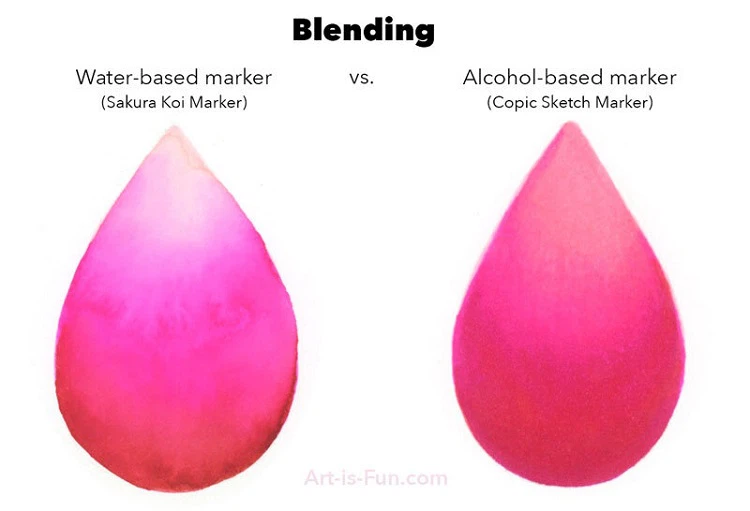
Both water-based and alcohol-based markers are capable of blending, but each has its ups and downs. Note that blending performance is heavily reliant on the paper you’re using. For instance, I’ve found that alcohol-based markers blend fantastically on marker paper, but when I tested them on heavyweight multimedia paper it was difficult because the paper was too absorbent.
Blending with water-based markers
Water-based markers can leave streaks when you’re blending, and create unwanted darker areas when you accidentally layer strokes.
Excessive blending can can also warp or damage paper, which is why you should use watercolor paper (because it’s tough) or marker paper, which is less absorbent, thereby allowing you more time to blend. (That said, water-based markers can tear or pill just about any type of paper, including watercolor paper and marker paper, depending on your technique.)
Water-based markers can be re-activated after they’ve dried, which allows you to lighten them with water or create washes (but the downside is you might accidentally ruin an area you’d already finished by getting it wet).
Blending with water-based markers can be more unpredictable than blending with alcohol markers because water can react with the dye in unexpected ways that can be difficult to control. While some may find this frustrating, it’s a trait that many watercolorists appreciate, so if you’ve got experience with watercolor paint, your skills will transfer well to blending with water-based markers.
You can also dip the tip of your marker in water to create a smooth transition in tone and saturation (from light to dark).
Blending with alcohol-based markers
Alcohol-based markers, on the other hand, blend more smoothly, but because they dry very quickly, you have to move fast. And once they’re dry, that’s it - the colors are very difficult to remove and any additional blending will darken or alter the existing colors. These qualities can make it difficult to smoothly cover large areas with alcohol-based markers or create large gradients (but it’s perfect for smaller areas).
Because alcohol markers are partially transparent, you can layer colors on top of one another to create different shades or tints.
Blending with alcohol markers is more predictable than blending with water-based markers, in that you know how the colors will interact so it’s pretty easy to replicate previous blends.
One downside with alcohol markers is that they can bleed through the paper. For this reason, I like to use my Copics on thick cardstock or marker paper. But if you’re planning to use them in coloring books (most of which have thin paper) you should put some scrap paper behind the page you’re coloring (or gently tear the page out and then color it on top of scrap paper) so that the dye can’t stain other pages.
Lightfastness
All art media will fade over time as light, oxygen and humidity gradually break the chemical bonds of the molecules that produce the color. The ability to resist color fading is called lightfastness. If you’re creating artworks that you hope to preserve, it’s a good idea to find media classified as lightfast or archival, which can hold their color for decades. But beware, you can’t always trust these labels.
As I’ve already mentioned, markers get their color from dye, which is more susceptible to fading than the pigments you’d find in paint, pastels or pencils. For this reason, the vast majority of markers are not truly lightfast (for example, “permanent” markers will also fade).
